What Is RWA Tokenization and How Does It Function?
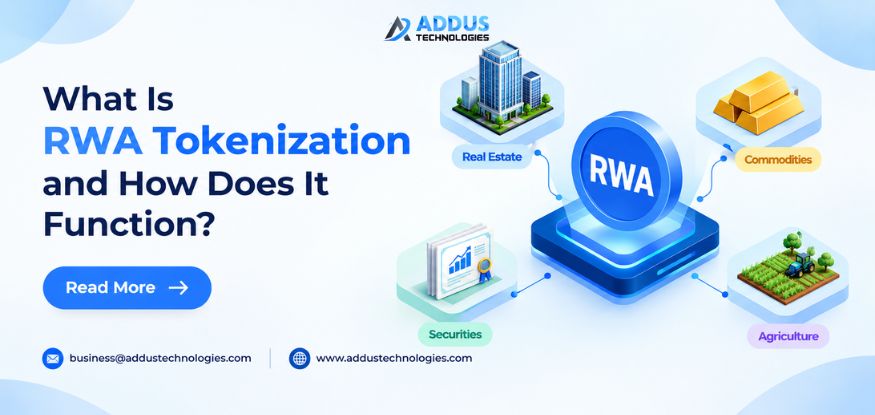
RWA tokenization is the method of creating digital tokens on a blockchain that represent real-world assets. The assets can be either tangible or intangible, including real estate, bonds, and products, on a blockchain, forming Digital Tokens for Real World Asset.
Tokenizing assets to make them more accessible, enable ownership, increase liquidity, and increase transaction transparency is something that many businesses and investors are considering. This article explains what RWA tokenization is, how it operates, the kinds of assets that can be tokenized, various applications, platform components, the development process, cost, difficulties, and opportunities.
What Are Real-World Assets (RWAs)?
Real-World Assets (RWAs) refer to tangible or intangible assets that exist outside of the blockchain. These assets comprise real-world property, commodities, bonds, art, and private equity.
Traditionally, the ownership of these assets is documented by legal, registry, or financial systems. The blockchain representation of these assets encodes ownership rights in the form of digital tokens called Asset Tokens.
What Is RWA Tokenization?
RWA Tokenization converts claims, ownership interests, or rights connected to physical and financial assets into tokens for Real-World Asset Tokenization.
A token may signify complete ownership, partial ownership, or an economic claim, depending on how it is structured. In order to provide a verified digital record that can facilitate more effective asset management and transactions, blockchain keeps track of these tokens and their transfers.
How Does RWA Tokenization Work?
RWA Tokenization combines an asset’s legal and economic value with blockchain records through a systematic Blockchain Asset Tokenization process.
Step 1: Asset Identification
The initial stage in the process is to select an asset that can be tokenized. Tokens allow the asset issuer to establish its ownership structure, value, location, and the rights that investors will have.
Step 2: Due Diligence and Valuation
To verify its existence, ownership, condition, and legal status, the chosen asset is put through a verification process. Its market worth may also be ascertained by independent valuation, which would assist in creating a suitable foundation for token issuance.
Step 3: Legal and Regulatory Structuring
Legal professionals determine relevant legislation and establish the token’s relationship to the underlying asset. Investor rights, transfer limitations, compliance standards, and asset issuers’ obligations are all outlined in this structure.
Step 4: Token Design
The token is designed according to the asset’s ownership model and investor rights. Its structure determines whether it represents full ownership, fractional interests, income rights, or another legally defined claim.
Step 5: On-chain contract
On-chain contracts are the rules that govern the decision about creating tokens, moving tokens, and handling actions on the chosen blockchain. These automated agreements control how token issuance happens. Developers encode relevant rules and controls to support Blockchain Asset Tokenization and automated transactions
Step 6: Token Issuance
Once the legal, technical, and compliance requirements are completed, tokens are created on the selected blockchain. The issued supply is linked to the underlying asset according to the established tokenization model.
Step 7: Distribution and Trading
Tokens can then be offered to eligible investors through an appropriate platform or marketplace. Depending on regulatory requirements, investors may purchase, hold, transfer, or trade their tokenized interests.
Step 8: Ongoing Asset Management
After issuance, the underlying asset and its tokens require continuous management. This can include ownership updates, valuations, distributions, compliance checks, reporting, and maintaining accurate links between the asset and its digital representation.
What Assets Can Be Tokenized?
Many types of Real-World Assets can become Tokenized Real-World Assets when their ownership, legal rights, valuation, and custody are established. The most common categories include:
| Asset Type | What can be tokenized? | Example |
|---|---|---|
| Real Estate | Ownership interests or fractional property rights | Apartments, commercial buildings, land |
| Gold and Commodities | Claims linked to stored physical commodities | Gold, silver, agricultural products |
| Bonds | Ownership or claims associated with debt instruments | Government bonds, corporate bonds |
| Private Equity | Ownership interests in privately held companies | Startup or private company shares |
| Art and Collectibles | Rights connected to valuable items | Paintings, rare collectibles, luxury assets |
| Investment Funds | Fund interests or participation rights | Real estate funds, private investment funds |
| Intellectual Property | Economic rights or revenue interests | Intellectual property and usage rights |
Why Is RWA Tokenization Important?
- Fractional Ownership: Investors can access smaller portions of high-value assets without purchasing the entire underlying asset.
- Improved Liquidity: Tokenized interests can make traditionally difficult-to-sell assets easier to transfer between eligible participants.
- Global Accessibility: This allows people from different regions to invest according to their local norms and regulations.
- Increase Transparency: It becomes easier to monitor things such as ownership of the asset, details about the asset, and transaction details.
- Streamlined Process: By means of automation, we are able to simplify our distributions, transfers, compliance laws, and other pre-planned processes.
Real-World Use Cases of RWA Tokenization
RWA Tokenization can be applied beyond simple Asset Tokenization. Its practical value appears when businesses use blockchain infrastructure to restructure investment access, ownership administration, financing, settlement, or asset distribution.
Real Estate Investment
Property businesses can use tokenization to structure investment opportunities around individual properties or portfolios. Instead of managing every investor through traditional paperwork, ownership records, distributions, and eligible transfers can be handled through a digital investment framework.
Tokenized Securities
Financial institutions can use blockchain-based securities to streamline issuance and ownership administration. For example, a company issuing debt can create digital representations for eligible investors, while transaction records and predefined transfer conditions are maintained through blockchain infrastructure.
Commodity Markets
Commodity businesses can use tokenization to create digital claims connected to assets held in verified custody. This can support more convenient transfers between participants without requiring the underlying commodity itself to physically change hands during every transaction.
Private Credit
Private lenders can structure loan participation digitally and make portions of eligible credit opportunities available to investors. Token-based records can help track investor interests, repayment schedules, and distributions throughout the life of a lending arrangement.
Art Investment
Tokenization can create new investment structures for expensive artwork by dividing economic interests among multiple participants. This can allow eligible investors to participate in an art-related investment without requiring one investor to finance the entire acquisition.
Fund Management
Fund managers can use blockchain infrastructure to maintain digital records of investor interests and automate selected administrative activities. Subscription records, ownership changes, reporting, and distributions can potentially be coordinated through a unified platform rather than fragmented systems.
What Is an RWA Tokenization Platform?
An RWA Tokenization Platform is a digital system that enables asset issuers to create, manage, and distribute blockchain-based asset tokens. Issuers use it to onboard assets and define ownership, while investors can discover, purchase, hold, transfer, and monitor eligible tokenized investments through the platform.
Key Components of an RWA Tokenization Platform
Asset Management
Enables asset issuers to add, organize, verify, and monitor underlying assets while maintaining relevant ownership details, valuations, documentation, and asset-specific information.
Token Issuance
Allows authorized issuers to create tokens according to predefined ownership structures, supply limits, investor rights, and distribution requirements established for each asset.
Investors Dashboard
It’s a special place for investors to monitor their tokens, view opportunities available to them, review transactions made before, and see their payouts.
KYC/AML Integration
Connects transaction-screening and identity verification services to assist in determining if users are eligible to access or transfer tokenized assets.
Wallet Integration
Users can securely receive, hold, transfer, and manage their tokens without ever leaving the platform environment by connecting appropriate blockchain wallets.
Token Marketplace
Offers a specific setting where qualified users can find Tokenized Real-World Assets, examine investment information, and engage in trading when allowed.
Compliance Management
Helps administrators apply regulatory requirements through investor restrictions, transfer controls, documentation, eligibility rules, and compliance workflows relevant to different tokenized offerings.
Transaction Tracking
Logs the movement of tokens and any activities related to these tokens, enabling the issuer, investor, and administrator to monitor transactions and ownership changes.
Admin Dashboard
Gives platform operators centralized control over users, assets, token offerings, transactions, compliance activities, platform settings, and operational monitoring.
What Is the RWA Tokenization Development Process?
RWA platform development consists of numerous interconnected stages, ranging from identifying business objectives to installing and maintaining a safe system for issuers and investors.
Step 1: Requirement Analysis
Before entering into development, be clear about your target assets and audience, the jurisdictions of the country you choose to operate your platform in, how people will invest in your blockchain platform, and platform features
Step 2: Platform Architecture
Decide on how each element of the platform architecture should connect and work as an integrated system. These elements consist of blockchain, smart contracts, back end, database, wallets, compliance solution, and interface for users.
Step 3: Selecting a Blockchain
Selection of the blockchain is done through an assessment of various factors such as the costs involved, interoperability, scalability, smart contract capability, ecosystem development, and others.
Step 4: Smart Contract Creation
Build contracts that govern token creation, ownership, transfers, investor restrictions, distributions, and other predefined rules while aligning functionality with the platform’s legal structure.
Step 5: Frontend & Backend Development
Develop the investor and administrator interfaces alongside backend services that manage users, assets, transactions, permissions, data, and communication with blockchain networks.
Step 6: Third-Party Integrations
Connect essential external services such as KYC/AML providers, payment systems, custodians, wallets, identity verification tools, data providers, and other required infrastructure.
Step 7: Security Testing
Test On-chain contracts, APIs, wallets, authentication, access controls, and platform workflows to identify vulnerabilities before real assets and investor funds are introduced.
Step 8: Launch of the Platform
This phase involves setting up everything needed for the start of the project after all checks are completed, like establishing the needed infrastructure, deploying the verified smart contracts, and connecting the main services, etc. After completing these steps, the project is officially launched.
Step 9: Ongoing Updates
It includes constant observance of the platform functions, elimination of weaknesses, modernization of the integrations, and changes in the platform according to current business, blockchain, and regulation changes.
What Factors Affect RWA Tokenization Development Cost?
Platform complexity, blockchain selection, smart contract scope, compliance needs, wallet and marketplace functionality, security audits, integrations, and bespoke features all affect the RWA Tokenization Development Cost.
While sophisticated compliance protocols, various wallets, marketplace features, complex integrations, stringent audits, and bespoke functionality can greatly increase the entire development effort, a basic platform requires fewer resources.
What Are the Challenges of RWA Tokenization?
- Regulatory Compliance: Meeting securities, financial, and asset-specific regulations can vary across jurisdictions and token structures.
- Asset Verification: Confirming an asset’s existence, condition, valuation, and ownership requires reliable documentation and verification processes.
- Legal Ownership: Clearly connecting blockchain tokens with enforceable ownership rights requires carefully structured legal agreements.
- Liquidity: Finding enough eligible buyers and sellers can remain difficult for specialized tokenized assets.
- Smart Contract Security: Contract vulnerabilities can affect token transfers, ownership rules, distributions, and other automated platform functions.
Which Blockchain Is Suitable for RWA Tokenization?
There are multiple factors that can determine whether one blockchain would be suitable for the process of asset tokenization.
| Blockchain Factor | What to Consider |
|---|---|
| Security | Network reliability, consensus strength, and smart contract security |
| Scalability | Transaction capacity and ability to support growing users and assets |
| Transaction Cost | Fees for issuing, transferring, and managing tokens |
| Smart Contract Capability | Flexibility to implement token rules and asset-specific logic |
| Ecosystem | Developer tools, wallets, applications, and available infrastructure |
| Interoperability | Ability to connect with other blockchains and external systems |
What Is the Future of RWA Tokenization?
As financial institutions investigate tokenized markets and real-world asset tokenization, institutional adoption may increase.
Tokenized Real-World Assets may be connected to changing financial ecosystems through DeFi integration, increased blockchain usage, and rising demand for digital asset infrastructure.
Why Choose Addus Technologies for RWA Tokenization Development?
By integrating blockchain technology with physical assets, RWA tokenization opens up new avenues for asset management, ownership, and investment. The method can change how companies and investors deal with assets that are often illiquid, from token issuance and compliance to trading and continuous management.
Addus Technologies helps businesses with RWA Platform Development, including platform architecture, smart contracts, compliance features, integrations, and investor-focused functionality. Ready to Launch Your RWA Tokenization Platform? Explore our RWA Tokenization Development services and take the first step toward launching your solution.
Frequently Asked Questions About RWA Tokenization
What is RWA tokenization?
RWA tokenization converts real-world asset rights into digital blockchain-based tokens. These tokens can represent ownership, fractional interests, or defined economic claims.
How does RWA tokenization work?
It links an asset’s legal and economic rights to blockchain-based tokens. The process includes asset verification, legal structuring, token design, issuance, distribution, and management.
What kind of assets can be tokenized?
Tokenization can be done on real estate, bonds, commodities, private equity, investment funds, art, and intellectual property. The legal aspect decides the suitability of assets.
Is Tokenization for RWA legal?
When constructed in accordance with relevant rules and regulations, RWA tokenization may be lawful. The requirements differ according to investor eligibility, token structure, asset kind, and jurisdiction.
What is an RWA tokenization platform?
An RWA tokenization platform enables issuers to create, manage, and distribute blockchain-based asset tokens. Investors can access, hold, transfer, and monitor eligible tokenized investments.