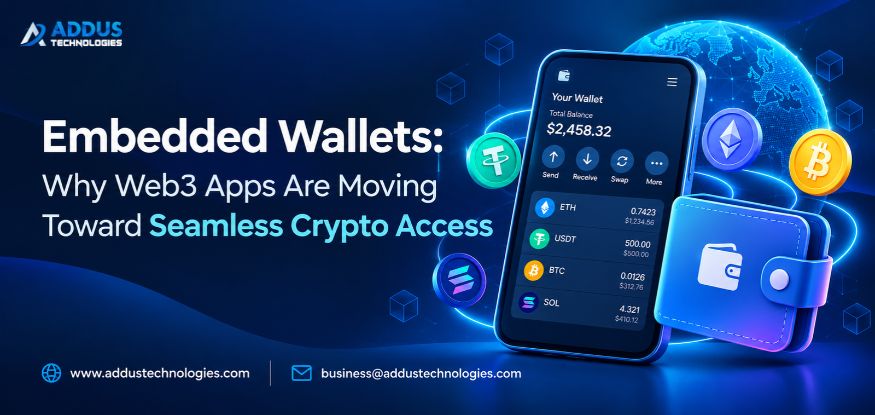
Embedded Wallets: Why Web3 Apps Are Moving Toward Seamless Crypto Access
Embedded wallets bring crypto access directly into Web3 applications, so users can create, manage, and use a wallet without constantly switching to another platform. By fitting wallet functions into familiar app experiences, they can make blockchain interactions feel less complicated and more natural. Understanding how they work, where they are used, and how security and architecture choices shape them helps businesses evaluate their role in modern Web3 products.
What Are Embedded Wallets?
Embedded wallet technology integrates blockchain wallets directly into a software’s interface and account system. Instead of treating the wallet as a separate product, the platform incorporates wallet functions into its existing user journey. Depending on the architecture, users may access wallet capabilities through email, social authentication, passkeys, or other supported methods.
An embedded crypto wallet can support functions such as wallet creation, asset management, transaction signing, and blockchain interactions without requiring users to repeatedly switch applications. This differs from connecting an external wallet, where the user maintains separate wallet software and authorizes connections between that wallet and the Web3 product.
How Do Embedded Wallets Work?
The process connects a platform’s account system with blockchain wallet infrastructure, forming a practical foundation for embedded wallet development through several stages:
- User authentication: The user signs up or logs in using an authentication method supported by the ecosystem.
- Wallet creation or linking: The system creates a wallet for the account or links an existing wallet according to the chosen architecture.
- Key management: Cryptographic keys or signing components are generated and protected using the security model selected by the web3 service.
- Transaction initiation: When a user performs an on-chain action, the application prepares the required transaction details.
- Transaction signing: The wallet’s signing mechanism authorizes the transaction after the required user or application checks are completed.
- Blockchain submission: The signed transaction is sent to the relevant network, where it is processed and recorded according to the blockchain’s rules.
Why Are Web3 Apps Moving to Embedded Wallets?
Businesses are adopting embedded wallets for Web3 apps to gain greater control over the product experience while reducing dependency on external wallet interfaces. For platforms targeting mainstream users, requiring separate wallet installation and configuration can introduce an unnecessary barrier before users reach the product’s core value.
A Web3 embedded wallet lets businesses design wallet interactions around their own account and product flows. This can help reduce abandonment during onboarding, keep users focused on Web3 solution features, and make blockchain functionality feel like part of the product rather than an additional tool.
The business value of embedded wallet technology also extends to product design. Developers can decide where wallet creation, transaction authorization, asset access, and other blockchain actions appear within the platform. This creates a more consistent journey and can make it easier to introduce blockchain features gradually.
Embedded Wallets vs Traditional Crypto Wallets
| Factor | Embedded Wallet | Traditional External Wallet |
|---|---|---|
| Wallet access | Inside the application | Separate wallet |
| User onboarding | Usually simpler | Additional setup |
| User experience | App-integrated | Requires wallet connection |
| Key management | Depends on architecture | Often user-managed |
| Application integration | Direct integration | External connection |
| Transaction experience | Integrated into app flow | Often requires wallet interaction |
An embedded approach fits products where wallet functions are closely tied to the main application, while external wallets may suit users who value independent wallet control, portability, and access across many unrelated ecosystems.
What Are the Key Features of Embedded Wallets?
Simplified Wallet Creation and Onboarding
Crypto wallet integration can be incorporated into account registration, reducing standalone setup tasks. This helps products make blockchain functionality available from the start without making wallet configuration the user’s first major activity.
Authentication and Account Recovery
Software can connect wallet access with email, social login, passkeys, or other supported authentication methods. Recovery mechanisms provide an additional route for restoring access when users lose their normal authentication method.
Multi-Chain and Asset Support
Multi-chain support allows a Web3 embedded wallet to work with selected blockchain networks and their compatible assets. This gives applications room to expand across ecosystems without designing an entirely separate wallet journey.
Transaction Signing and Blockchain Interaction
Users can authorize on-chain actions from the product interface. The signing layer handles transaction approval while the interface supplies the surrounding context, such as the action being performed and the requested network.
Key Management and Security Controls
Key-management systems are essential in embedded wallet development, securing credentials for transaction authorization. Authentication, permissions, encryption, recovery policies, and access controls strengthen signing operations.
Are Embedded Wallets Secure?
Embedded wallets can be designed with strong security controls, but their security depends on the underlying authentication, key-management, recovery, and transaction-signing architecture.
Security should work through connected layers: Authentication controls account access, Key protection secures signing credentials, Transaction authorization limits unintended actions, and recovery controls handle account-access failures.
Businesses must also account for smart contract vulnerabilities, platform permissions, infrastructure security, and monitoring. Custodial and non-custodial models create different responsibilities around key control and recovery.
Therefore, security is not a property of the wallet label alone. It depends on how the complete application architecture protects accounts, signing authority, transactions, and recovery paths.
What Is the Difference Between Custodial and Non-Custodial Embedded Wallets?
Custodial Embedded Wallets
In a custodial model, the business or its wallet infrastructure provider controls the keys or signing authority on the user’s behalf. This can simplify recovery and support, but it creates greater responsibilities for security, operations, custody, and applicable regulatory requirements.
Non-Custodial Embedded Wallets
A non-custodial model gives users greater control over their wallet credentials or signing authority. The business may provide the interface and supporting infrastructure without taking direct custody of user assets. Recovery therefore requires careful architectural planning.
Which Model Is Suitable for a Web3 Application?
| Consideration | Custodial | Non-Custodial |
|---|---|---|
| Key control | Business/provider | User-oriented |
| Recovery | Provider-supported | Architecture/user-dependent |
| Convenience | Generally higher | Can require more user responsibility |
| Business responsibility | Greater custody responsibility | Less direct custody responsibility |
| Control model | Provider-managed | User-controlled |
The suitable model depends on the platform’s users, operating model, security expectations, recovery design, business responsibilities, and regulatory environment rather than a universal preference for either approach.
Where Are Embedded Wallets Used?
DeFi Applications
In DeFi, crypto wallet integration can support transaction authorization for swaps, lending, staking, and related actions. This reduces the separation between a user’s account, selected protocol function, and required blockchain transaction.
Web3 Gaming
Games can connect wallet functionality with player profiles and in-game assets. Players may receive, manage, or transfer blockchain-based items without treating wallet management as a completely separate gaming activity.
NFT Marketplaces
NFT marketplaces can connect wallet functions with purchasing and transfer workflows, letting users authorize ownership transactions during marketplace actions and move from asset discovery to blockchain settlement.
Crypto Payment Platforms
Payment platforms can place embedded wallets for Web3 apps within checkout, deposits, withdrawals, or account balances. This can simplify how users interact with supported digital assets during payment-related activities.
Web3 Social Applications
Social platforms can use wallet functionality for token-gated communities, digital collectibles, and blockchain-based identity features, linking wallet actions directly with familiar social interactions within the same platform.
Tokenized Platforms
Tokenized asset platforms can associate wallet functions with ownership and transfer workflows. This helps users interact with supported tokenized assets while the platform coordinates relevant blockchain transactions and ownership records.
What Are the Benefits of Embedded Wallets for Web3 Businesses?
- Higher onboarding completion: Removing unnecessary setup steps can help more prospective users reach the product’s core functionality.
- Lower user drop-off: A shorter path to blockchain features can reduce abandonment caused by unfamiliar wallet requirements.
- Consistent product experience: Businesses can design wallet interactions to match the application’s existing interface and navigation.
- Greater product control: Teams can decide how wallet actions, permissions, and transaction prompts fit into specific user journeys.
- Easier feature expansion: A shared wallet layer can support additional blockchain functionality as the product evolves.
- Flexible architecture: Businesses can select custody, recovery, authentication, and network arrangements according to their operating requirements.
What Challenges Should Businesses Consider?
- Security architecture: Embedded wallet development needs carefully designed authentication, authorization, key protection, monitoring, and transaction controls.
- Key management: Businesses must establish how signing credentials are generated, protected, accessed, recovered, and governed.
- Custody and compliance: Custodial arrangements can create additional operational, legal, and regulatory responsibilities that vary by jurisdiction.
- Multi-chain complexity: Supporting different networks introduces variations in transactions, assets, fees, infrastructure, testing, and maintenance requirements.
- User portability: Businesses should plan how users can recover, export, migrate, or otherwise retain access to assets if application access changes.
How to Choose an Embedded Wallet Architecture
Choosing an embedded wallet architecture starts with understanding who will use it and how they will access funds. Businesses should weigh custodial or non-custodial control, supported networks, authentication methods, key management, recovery options, transaction authorization, and the level of security required.
The architecture of a Web3 embedded wallet should also match expected transaction volume, growth, and integration needs. A design suitable for a small Web3 app may not fit a high-volume platform. Evaluate scalability, existing systems, APIs, user flows, compliance needs, and operational complexity before selecting the model.
What Is the Future of Embedded Wallets in Web3?
- Passkey-based access: Passkeys may provide familiar authentication while supporting wallet experiences designed around stronger account protection.
- Account abstraction: Smart-account models can enable programmable transaction rules, sponsored transactions, and more flexible user interactions.
- Multi-chain experiences: Wallet infrastructure is likely to support broader network coverage without requiring separate experiences for each chain.
- Programmable permissions: Applications may offer controlled signing permissions suited to recurring or predefined blockchain actions.
- Consumer Web3 products: Gaming, payments, and social platforms can continue moving blockchain functions closer to everyday product workflows.
- Wallets as infrastructure: Embedded wallet technology may increasingly become an underlying product component rather than a separate product users actively manage.
Frequently Asked Questions About Embedded Wallets
What is an embedded crypto wallet?
An embedded crypto wallet is a blockchain wallet integrated into a platform. Crypto wallet integration allows users to access wallet functions through the product’s own interface, with custody and key control determined by the underlying architecture.
How does an embedded wallet work?
The application authenticates the user, creates or links a wallet, manages signing credentials according to its architecture, and prepares blockchain transactions. The wallet then authorizes transactions before they are submitted on-chain.
Are embedded wallets secure?
They provide protection when authentication, key management, transaction authorization, encryption, recovery, and application security are designed. However, security relies on implementation rather than the embedded model alone.
What is the difference between an embedded wallet and a traditional crypto wallet?
An embedded wallet is integrated into an application’s account and interface, while a traditional wallet operates independently. The main distinction is how wallet functions are accessed and connected to the software.
Are embedded wallets custodial or non-custodial?
They can be either. Custodial designs place key control with a business or provider, whereas non-custodial architectures give users greater control over signing authority and asset access.
Can embedded wallets support multiple blockchains?
Yes. Depending on the implementation, a single wallet experience can support multiple blockchain networks and compatible assets. Each additional network still requires appropriate integration, transaction handling, testing, and monitoring.
Can businesses integrate embedded wallets into Web3 applications?
Businesses can integrate embedded wallets for Web3 apps through authentication, wallet infrastructure, blockchain connectivity, transaction signing, recovery mechanisms, and chosen architecture.
What applications can use embedded wallets?
DeFi platforms, Web3 games, NFT marketplaces, payment systems, social applications, and tokenized platforms can use them when integrated wallet functions support their specific user and transaction workflows.
Conclusion
Embedded wallets bring wallet creation, authentication, asset management, and transaction signing into familiar application experiences. Their effectiveness depends on custody model, key-management approach, security controls, recovery process, network support, and scalable architecture.
For businesses planning seamless blockchain experiences, Addus Technologies can help turn these requirements into practical wallet infrastructure aligned with product goals and user needs. Ready to make crypto access feel effortless? Build your embedded wallet experience with Addus and move your Web3 product forward.