How Verifiable Credentials Work in Decentralized Identity Systems
Introduction
The same set of certificates has to be presented by individuals to a university, office, bank, and many other institutions. It may take some time, even though it is the responsibility of the issuing organization to ensure that the information is verified and correct. Here is the place where Verifiable Credentials in Decentralized Identity help by provide digital signatures as a authority of the certifications.
For companies, the hardest task is to know how to work with Verifiable Credentials in decentralized identification, how to integrate them into their systems, and who can create, present and validate them. This task is described by the necessity to check certain data, by the ownership of the information and by the involvement of the other parties in the validation process.
What Are Verifiable Credentials?
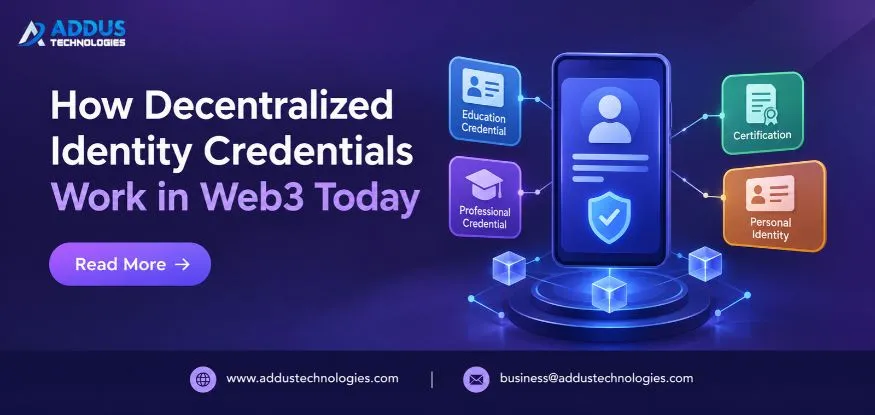
Verifiable Credentials in Decentralized Identity is a digital documents that contain information claims about the identity of an entity made by an company or a original authority. Verifiable credentials vary from the usual digital certificates in the sense that they contain cryptographic proofs that allow their verification.
For example, a university can give a digital degree credential to its graduate and pass it to the employer. Credentials have claims within, and verifiable presentations package the data with a specific purpose in mind. An employer checks the proof, the issuer’s authority, and claim relevance and relies on them.
How Do Decentralized Identity Systems Work?
What Is a Decentralized Identifier (DID)?
Decentralized Identifiers (DIDs) are identifiers of entities that can be resolved to obtain verification information using the associated method. It is possible for the resolution to provide cryptographic data, like public keys, needed to verify the proof. A DID identifier itself is not a credential but stores the data needed to verify it.
Who Are the Issuer, Holder and Verifier?
An issuer is an organization or a service that creates and signs claims. A holder is a person or a system that receives the verifiable credential and may present it to a verifier. A verifier checks the presented claims, their proof of issuance, and relies on them. These three are the people who determine how Verifiable Credentials Work.
What Is a Digital Identity Wallet?
Digital Identity Wallets are wallets used by users to keep credentials and make their claims. In the Decentralized Identity System, a credential contains claims, a DID identifier stores information about an entity, a wallet manages credentials and they are used in different ways.
How Do Verifiable Credentials Work?
Step 1 – Credential Issuance
At the time of issuance, an authorized participant prepares claims about the subject of a credential and protects it with a cryptographic signature using an appropriate mechanism. Verifiable Credentials Development should consider the issuer’s authority, fields of data to be included in the claims, validity time frame, and verification process.
Step 2 – Credential Storage
A holder stores a verifiable credential in a secure place or in a wallet designed to store multiple credentials. Particular attention should be paid to protecting the wallet from unauthorized access and making it possible to recover the data held in it upon loss of access.
Step 3 – Credential Presentation
When an application is received to present a credential, a holder provides it or prepares a presentation containing the data requested. Supported selective disclosure methods can help reduce the amount of data shared, depending on the type of credential and proof mechanism.
Step 4 – Credential Verification
Decentralized Identity verification checks cryptographic proofs, their authenticity, and validity. Decentralized Identity systems then evaluate the authority of the issuer and verify claims. If appropriate, the verifier checks the revocation status or other information about the credential’s validity.
Step 5 – Application-Level Validation
A valid signature does not prove that all claims are true or that it is related to all decisions. The application must check whether the authority of the issuer is verified, the claim is relevant and its rules are applicable.
Verifiable Credentials Architecture and Technical Components
Verifiable Credentials Architecture connects issuer services, credential formats, identifier resolution, holder storage, and verifier policies.
| Component | Main responsibility |
|---|---|
| Issuer backend | Creates and signs credentials |
| Data model and proof format | Structures claims and supports integrity checks |
| DID and verification method | Provides identifier-related verification information, where applicable |
| Holder wallet | Stores credentials and prepares presentations |
| Verifier application | Checks cryptographic proofs, issuer trust, and claim requirements |
| Status mechanism | Supports expiry, suspension, or revocation checks where available |
| Optional registry or blockchain | Publishes selected verification or status information |
For example, a university’s backend sends a signed qualification to a student’s wallet. The Recruitment System of an organization gets it, gathers verification information, verifies credential status, and applies hiring policies. The Credential Issuance and Verification process is based on the selected standards and interfaces.
Does Decentralized Identity Require Blockchain?
Verification credentials can be used along with ideal records, trusted databases, or any other type of technology that could help in releasing verification data. This is because the Blockchain Based Digital Identity could be used when the storage of common data is required.
When Blockchain May Help
Verification data, like the name of the issuer or the status, could be stored in a joint ledger and accessed by several firms. But it is necessary to take into account different aspects, including cost, performance, governance, confidentiality and so on. While developing such a ledger. Personal information kept on the blockchain needs to be verified from a privacy angle.
Standards and Interoperability in Verifiable Credentials
The approval for W3C Verifiable Credentials Data Model v2.0 as a W3C Recommendation took place on 15 May 2025. It describes how credentials encode claims and related information, without defining a complete implementation framework.
What Standards Need to Match
A Verifiable Credentials Architecture should structure the data models, formats, proof approaches and decentralized identifier methods if available. To verify the credential, it needs profiles, exchange methods and trust policies to check properly, even if you use standard credential methods
Real-World Use Cases of Verifiable Credentials
Education and Professional Certifications
Digital certificates can be provided to graduates and qualified persons by their institutions. Employers must validate the credentials and verify the authenticity of the issuing institution instead of simply using email certificates where it is possible for them to do so.
Enterprise Identity and Access Management
Identity verification might take place throughout the onboarding process for a company’s employees or contractors. Enterprise Decentralized Identity Solutions may enable employees to demonstrate their function or degree of training on several systems without having to resubmit the same documents each time.
Financial Services and Identity Verification
A financial service may accept customer attributes that are verified during the onboarding process, subject to local laws and compliance rules. Decentralized Identity Verification can help with checks, but it does not replace the necessary due diligence or a firm’s responsibility to assess risk.
Security, Privacy and Implementation Challenges
Protecting Credentials and Keys
Stolen wallet access or compromised private keys can expose credentials or allow misuse. Secure key storage, recovery controls, expiry checks, issuer vetting and credential status checks are essential parts of Digital Credential Security.
Limiting Data Exposure
Privacy-Preserving Identity Verification refers to asking for information that is necessary for decision making only. Selective disclosure can constrain the amount of claims made, but the linkable identifier, timestamp and repeated presentation can allow the service providers to tie together separate actions and determine what the individual does.
Handling Integration and Governance
Organizations must agree on trusted issuers, recovery procedures, compatible formats, and responsibility for status updates. Verifiable credentials development not only tests successful transactions, but it should also test failed verification, unavailable registries, lost devices, and outdated credentials.
How to Develop a Verifiable Credentials Solution
Define Credential Requirements
Determine the use case, claims to verify, projected credential volume, and acceptance criteria. To find the scope of the solution and the first development effort, record the required fields, validity periods and verification outcomes.
Map Credential Roles and Trust
Identify issuers, holders and verifiers, then document who approves issuers, handles lost credentials and updates status records. These decisions establish trust rules, responsibilities and integration needs.
Select Credential Standards and Formats
Compare credential formats, proof methods, and DID options for Web3 development with wallet compatibility, issuer requirements, and target standards. Document selected profiles and protocols before development begins.
Plan Issuance and Verification
Credential fields, signing methods, wallet interactions and verification rules should be specified for Verifiable Credentials in Decentralized Identity. Mapping of successful and failed presentations, which includes expired credentials and untrusted issuers, should be done before custom wallet implementation.
Apply Privacy and Security Checks
Set permissions for storage and recovery, data retention boundaris and credential progress checking. Set privacy criteria and perform tests based on stolen keys, third party access and rejected credentials.
Estimate Integration Requirements
To know which providers, applications, registries and databases are needed, it is important to understand what type of connections are required. To predict the results of the development process, you should know how to do mapping of data, contracts for API, etc.
Test Credential Interoperability
Test credential exchange across supported wallets and verifier systems, including invalid proofs, expired credentials, revoked status and unavailable services. Test result recording and critical failure correction before release
Plan Deployment and Maintenance
Before you launch, check more than once your hosting, system alarms, backup restoration and essential plans. Arrange for frequent security tests, software upgrades and regular maintenance along with other responsibilities and projected cost of operation.
Conclusion
Before issuing Verifiable Credentials in Decentralized Identity systems, companies must set what they want to verify, what issuers of credentials they will consider, how credentials may be rejected and what data will be available to the verifiers.
With Addus Technologies, you can define your implementation needs and develop a plan for deploying your application including issuing credentials, integration of wallets, verification logic, and system integration. Let’s start with picking up a single use case and all parties that are involved in credentialing.
Frequently Asked Questions
What is the distinction between a DID and a verifiable credential?
DID is used for identifying an individual or entity, while verifiable credentials consist of claims about an individual or entity which can be verified for authenticity by others.
Do Verifiable Credentials Require Blockchain?
No. Verifiable Credentials in Decentralized Identity can work without blockchain, using trusted registries or other verification methods based on the system’s design and requirements.
How Are Verifiable Credentials Verified?
Verification is done by checking on the digital evidence, the authenticity of the entity that issued the credential and the validity of the credential.
How Do Verifiable Credentials Protect Personal Information?
Verifiable credentials can remove unwanted data sharing through selective disclosure. However, privacy also depends on how identifiers, personal details, and related records are handled.
Can Businesses Build Custom Verifiable Credential Platforms?
Yes. Businesses can create unique verifiable credential platforms to fit their workflows, integrate with current systems, meet essential standards and manage credential issuance, storage and verification.